

Mother Mary Salome

The religious community of the Bar Convent, York, c. 1900, where Mother Mary Salome lived and worked.
Agnes Oates was born in Clifton, England, in 1860, into a family whose name would become closely associated with the revival of Catholic literature in nineteenth-century England. Her father, William Wilfred Oates, was a partner in the publishing house of Burns & Oates, which helped bring the writings of Cardinal Newman and many other Catholic authors to an expanding readership. Explore the history of Burns & Oates. Books were more than a family business: they were part of a great religious and cultural movement in which the Oates family played an active part. The world of Agnes's childhood in Portman Street would later give rise to her book Some Little London Children, a collection of stories that offers a glimpse of the everyday experiences of a Catholic family in England during this era.
In 1883, Agnes entered the novitiate at the Bar Convent in York, taking the religious name Mother Mary Salome. She pronounced her vows in 1885 and soon began a life of remarkable activity in the service of her community. From 1889 onward, she held a succession of important responsibilities, including Mistress of Schools at the Bar Convent, Superior of St. Mary's Convent in Cambridge, and Superior of the English community of her Institute in Rome. These appointments required administrative ability, sound judgment, and considerable energy—qualities she possessed in abundance, despite frequently poor health.
Yet the demands of religious life and administration did not prevent Mother Mary Salome from becoming a prolific author. In The Life of Our Lord Written for Little Ones, she presented the Gospel story for younger readers; in The Feasts of Mother Church and Saints and Festivals, she introduced children to the Church's liturgical year and the examples of the saints. Her writing belonged to the same tradition of Catholic education that had produced the celebrated works of her dear friend and fellow Bar Convent religious, Mother Mary Loyola.
Perhaps her most personally significant literary undertaking, however, was her Life of Mary Ward, an account of the courageous English foundress whose vision of an active religious apostolate for women met with fierce opposition both in recusant England and in the Church itself, but whose perseverance laid the foundations of the Institute to which Mother Salome belonged. In 1927, Mother Salome even traveled to Nymphenburg in Bavaria to assist in promoting the cause of her foundress's beatification, a cause to which she devoted much of her remaining strength.
After returning to Cambridge, declining health obliged her to relinquish her responsibilities and return to York in December 1928. Even then, she continued her work for Mary Ward's cause. In July 1931, Mother Mary Salome was sent to the Institute's small convent at Egton Bridge for rest and a change of air. The peaceful surroundings seemed at first to restore her health, but on July 20 she suffered a sudden stroke. She died four days later, on July 24, 1931, and was brought back to the Bar Convent for a solemn Requiem and burial. Her obituary in The Tablet remembered a woman whose extraordinary determination enabled her to accomplish far more than her physical strength might have suggested.
-

Mother Mary Salome
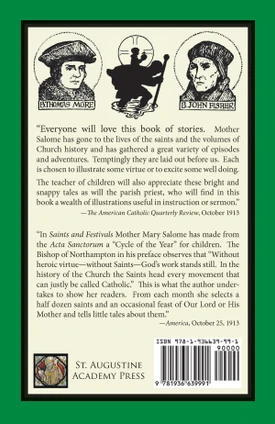
Saints and Festivals: A Cycle of the Year for Young People
$15.95Mother Mary Salome first wrote The Feasts of Mother Church in 1904, a volume of meditations upon many of the great feasts of the Liturgical Year. In 1913 she returned to the subject for a younger...